Agentic UX Principles & Patterns
Published Design Patterns for AI-Agentic Interfaces
A living reference of interaction patterns for AI-agentic interfaces — researched, written, and published as a GitHub Pages site for the FactSet UX team. The library covers 51 patterns across 7 principles, with 160+ use cases documented to help designers make consistent, principled decisions when designing agentic features.
I defined the principles, researched and documented all 51 patterns, and designed and built the published site — making the library accessible across the entire UX team as a shared reference.
- Data accuracy comes before speed: An agent that returns a faster but less reliable answer is not a better agent. Never imply certainty the underlying data does not support.
- Users can always stop the agent: At any point in any agentic workflow, the user must be able to pause, redirect, or cancel. There is no agent state from which exit is unavailable.
- Every consequential action is attributed: When an agent acts, the record of what it did, when, what data it used, and who authorized it must be durable and accessible.
- Agents never claim to be human: No agent should create ambiguity about whether the user is interacting with an AI system — across voice, conversational, and chat surfaces.
These principles exist in deliberate tension with each other. Transparency conflicts with efficiency. Authorization conflicts with speed. Scaffolding conflicts with power-user expectations. The job is finding a defensible position for each design moment.
Every agent action, decision, and output should be traceable to a readable explanation. Users must be able to trace any insight to its source.
Can conflict with efficiency — transparency adds steps
For any action that is consequential, irreversible, or external, the user must remain in the decision seat — both as experience and as a compliance record.
Can conflict with speed — authorization gates add latency
Trust is earned through demonstrated reliability, not granted upfront. A single unexpected action can erase trust built through many interactions.
Can conflict with onboarding speed — trust takes time to build
The gap between what a user says and what an agent does is where mistakes are made. Surface the agent's interpretation before it acts.
Can conflict with fluency — confirmation steps feel interruptive
Reduce first-use friction without limiting what experienced users can achieve. Scaffolding must recede as users grow, or it becomes condescending.
Can conflict with power-user expectations — scaffolding feels patronizing over time
A capable agent remembers. Users should never have to re-establish context. They should always be able to see what context the agent is working from.
Can conflict with privacy — persistent context raises data retention concerns
Users calibrate long-term trust based on how agents fail, not just how they succeed. An agent that expresses false certainty is more dangerous than one that says "I'm not sure."
Can conflict with confidence — visible uncertainty can erode user confidence
I built and deployed the patterns as a GitHub Pages site using Vue 3, Vite, and Tailwind CSS — with SPA routing, pill-tab pattern browsing, and DemoBadge components showing interactive pattern examples.
- Accessible to the entire UX team as a shared reference
- Structured for ongoing contribution — any designer can add a pattern
- Integrated prev/next navigation to encourage browsing across patterns
- 3 interactive demos: Portfolio Risk Analysis, Stock Screener, Insider Report
- Every pattern includes: definition, when to use, anatomy, anti-patterns
- Shared language: The team now has consistent terminology for agentic UX decisions across different product areas — "does this follow progressive disclosure?" is a concrete, answerable question.
- Faster design reviews: Pattern references replace lengthy debates. Reviewers can point to a documented anti-pattern instead of restating first principles every cycle.
- Onboarding resource: New designers and PMs use the site to understand FactSet's AI UX approach without needing to shadow senior designers for weeks.
- Foundation for design system: The principles feed into Fusion Design System's emerging AI component guidelines — grounding component decisions in user-facing rationale.
View Other Projects
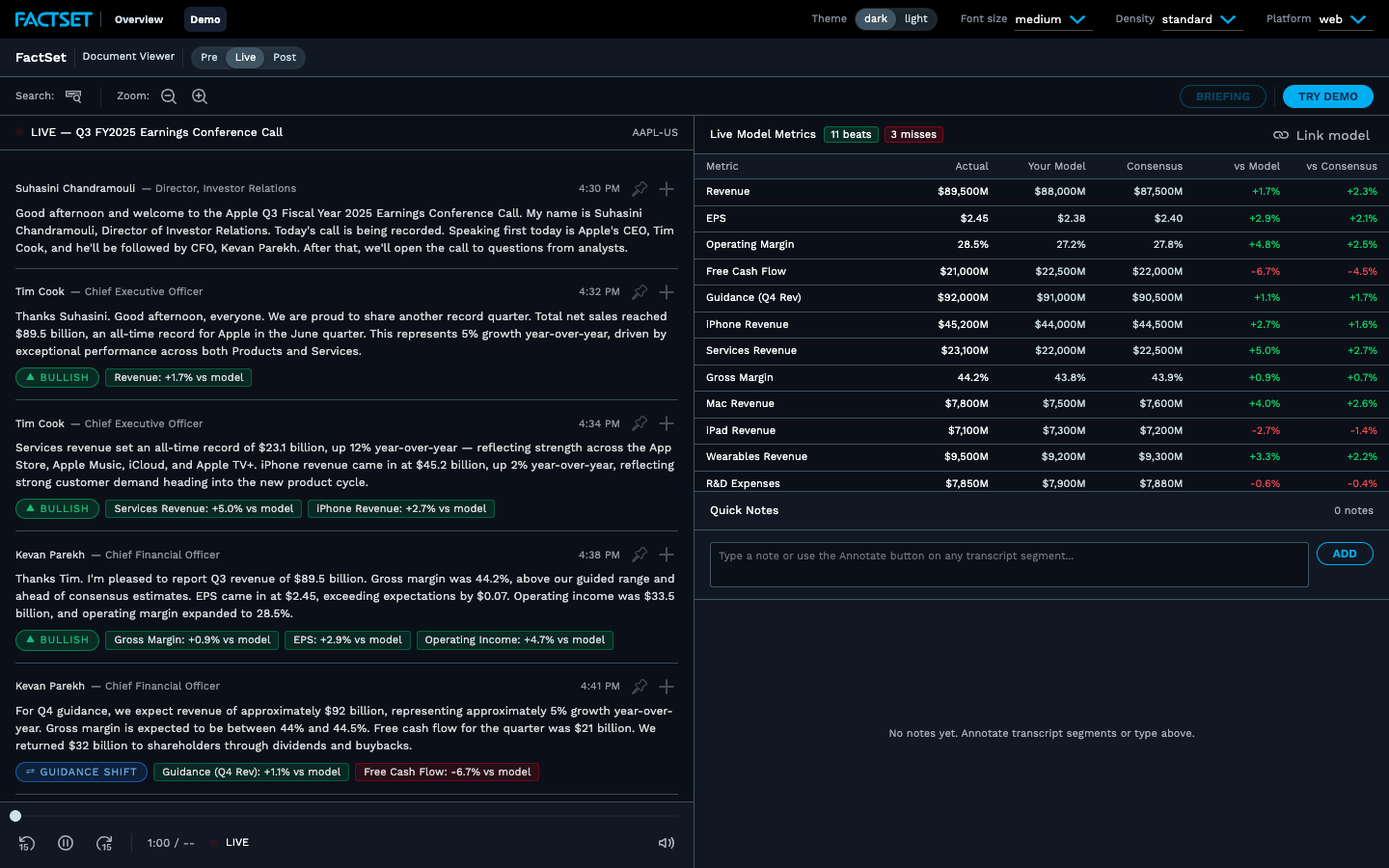
Earnings War Room
AI-powered live earnings research platform — transcript analysis, AI tiles, PM brief generation.
AI-Augmented UX Process
Discovery pipeline with persona modelling, need synthesis, and problem brief generation.